
Culture — Flag
The Dominican Republic Flag
Few national flags carry as much deliberate symbolism as the Dominican Republic's. Every color, every shape, and every element of the coat of arms was chosen to tell a specific story — one of hard-won independence, Christian faith, and the cost of liberty.
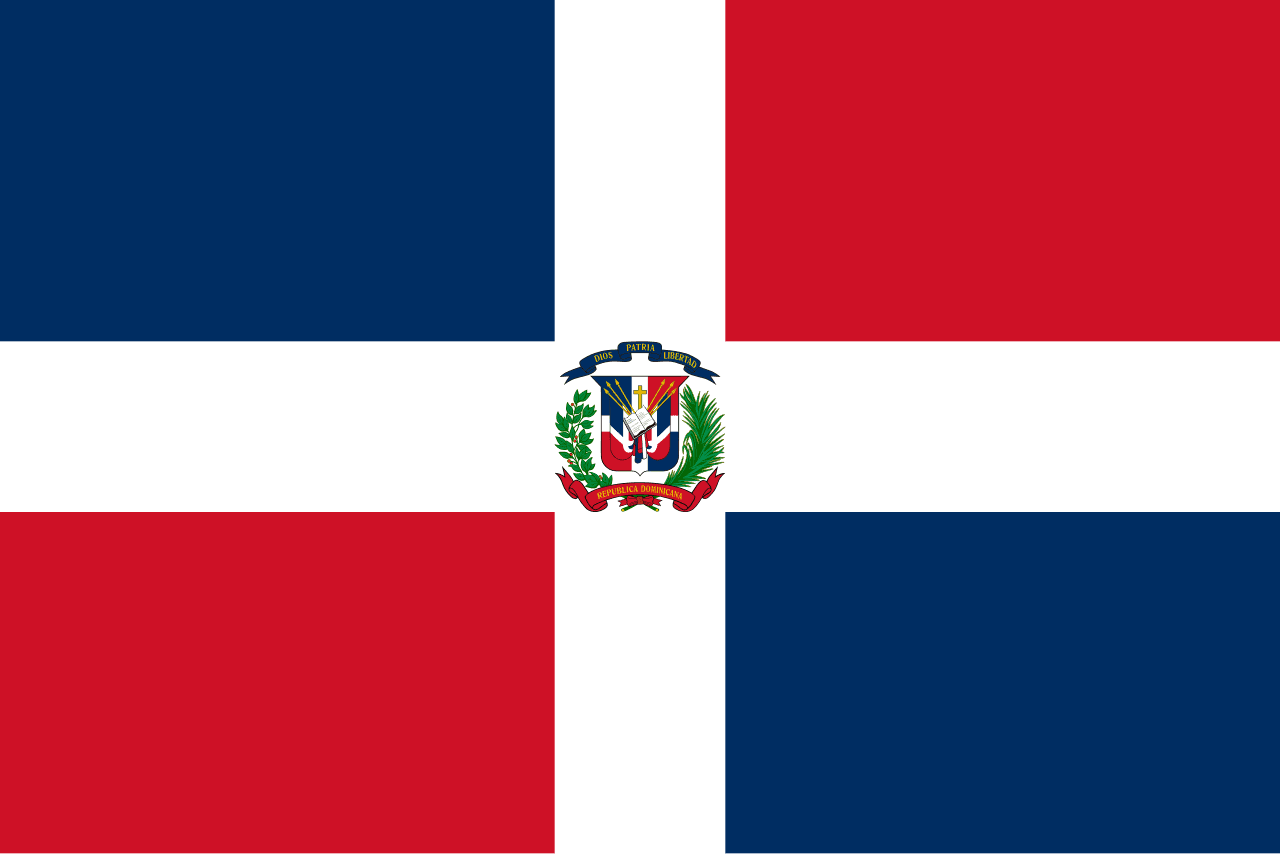
Flag of the Dominican Republic — adopted February 27, 1844
Adopted
Feb 27, 1844
Proportions
2 : 3
Colors
Blue, Red, White
Unique feature
Coat of arms
History of the flag
The Dominican Republic declared independence on February 27, 1844 — separating from Haiti, which had controlled the entire island of Hispaniola since 1822. The flag was designed as part of that founding moment, and has remained the national symbol ever since.
The flag's design is credited to Juan Pablo Duarte, the founding father of the republic and leader of a secret revolutionary group called La Trinitaria. Duarte adapted the Haitian flag — which was also blue and red — but added a white cross to distinguish the new nation and to represent the Christian values he believed should underpin Dominican society.
The original Haitian flag used a horizontal bicolor of blue and red. Duarte's innovation was to divide the flag into four quadrants using a centered white cross, swapping the arrangement of colors so the design would be visually distinct from the flag of the country the DR was breaking away from.
The coat of arms in the center was formalized over the years following independence and has gone through several revisions. The current version has been in use since 1913, though its core elements — the Bible, the cross, the motto — have been present since the earliest designs.
What the colors mean
Blue — Liberty
Blue represents freedom — the ideal that drove independence. It was the color chosen by Juan Pablo Duarte and the founding Trinitaria movement as a symbol of liberation from Haitian rule.
Red — The blood of patriots
Red honors those who sacrificed their lives for Dominican independence. It is a direct acknowledgment of the cost of freedom — the soldiers and fighters who died to establish the republic.
White — Salvation and peace
The white cross divides and unifies. It represents the Christian faith central to Dominican culture and symbolizes salvation, peace, and unity among the people.
The layout explained
The flag is divided into four equal quadrants by a centered white cross. The quadrants alternate blue and red in a diagonal pattern: blue sits in the upper-left and lower-right, while red occupies the upper-right and lower-left.
This arrangement is intentional — unlike most flags where a cross creates a simple horizontal/vertical split, the alternating color pattern gives the Dominican flag a dynamic, interlocking quality. No two adjacent quadrants share a color, and the white cross serves as the neutral boundary between them.
The coat of arms sits at the exact center of the cross, anchoring the entire design and making it one of the few national flags in the world to display its full coat of arms on both the front and back.
The coat of arms — element by element
The coat of arms is one of the most detailed in the Americas. Each element carries specific meaning rooted in Dominican history, faith, and national identity.
The shield
Divided into four quadrants by a white cross — two blue (upper-left and lower-right) and two red (upper-right and lower-left), mirroring the flag itself.
The open Bible
Centered on the shield, opened to the Gospel of John 8:32: "Y la verdad os hará libres" — "And the truth shall set you free." It represents the role of faith in Dominican identity.
The golden cross
Rising above the Bible and shield. A symbol of Christianity, which shaped the country's history, law, and culture from the earliest days of Spanish colonization.
Two laurel branches
Framing the shield on either side, these represent victory and honor — a classical symbol used across heraldry to mark a nation's pride in its achievements.
Upper ribbon (red)
Bears the words "República Dominicana" — the official name of the country.
Lower ribbon (blue)
Bears the national motto: "Dios, Patria, Libertad" — "God, Homeland, Liberty." These three words encapsulate the values the republic was founded upon.
Six flags
Three Dominican flags appear on each side of the shield, adding symmetry and reinforcing national identity within the coat of arms itself.
Two cannons and cannonballs
Positioned at the base of the shield, they represent the country's willingness to defend its sovereignty — hard-won after centuries of foreign rule.
National motto
Dios · Patria · Libertad
God · Homeland · Liberty
These three words appear on the lower ribbon of the coat of arms and are the foundation of the Dominican national identity. They were Duarte's words — a declaration that the republic would be built on faith, belonging, and freedom. The motto still appears on official documents, government seals, and is quoted in political speeches to this day.
What makes it distinctive
- The Dominican Republic flag is the only national flag in the world that contains the color purple — found in a small shield element within the coat of arms.
- It is one of the few flags where the coat of arms appears identically on both sides, making it reversible without any mirroring issues.
- The Bible on the coat of arms is one of only a handful of religious texts depicted on any national flag in the world.
- February 27 — the date independence was declared and the flag was first raised — is celebrated as Independence Day, one of the most significant national holidays.